

This is a double edition, slightly longer than usual as I took a week off for the New Year.
🧠 Will AI kill Python?
The GitHub Octoverse results are out, and TypeScript (TS) is now the most used language.
For context, on GitHub Octoverse 2024, Python dethroned JavaScript as the most used language across all work. There is no doubt that today, Python is still the undisputed king of AI and Data.
But here’s the irony: I’m a Python guy, yet I’ve been writing more JS/TS than ever.
I’m vibecoding apps with background jobs, and most of them rely on APIs, so TS fits perfectly this use case.
Why is TS gaining traction? TypeScript provides a much safer feedback loop for AI generation. Because LLMs can hallucinate APIs or import non-existent methods, TypeScript’s static typing acts as immediate “guardrails.” The AI (and the compiler) detects errors at the linting stage, not at runtime. It essentially allows the AI to self-correct before you even run the code.
Tools like Lovable and Replit that enable you to build apps with AI are targeting the web, so naturally, it’s all JS/TS. You can see why usage is exploding. That being said, Wasm might eventually shift the balance, but today, if I want to write for the web, it’s TS/JS.
🛠️ Holiday laptop cleaning with dua
Here we go again. My laptop drive is full, I have urgent things to do, and I need to quickly delete large files I don’t need (or worse, hidden cache).
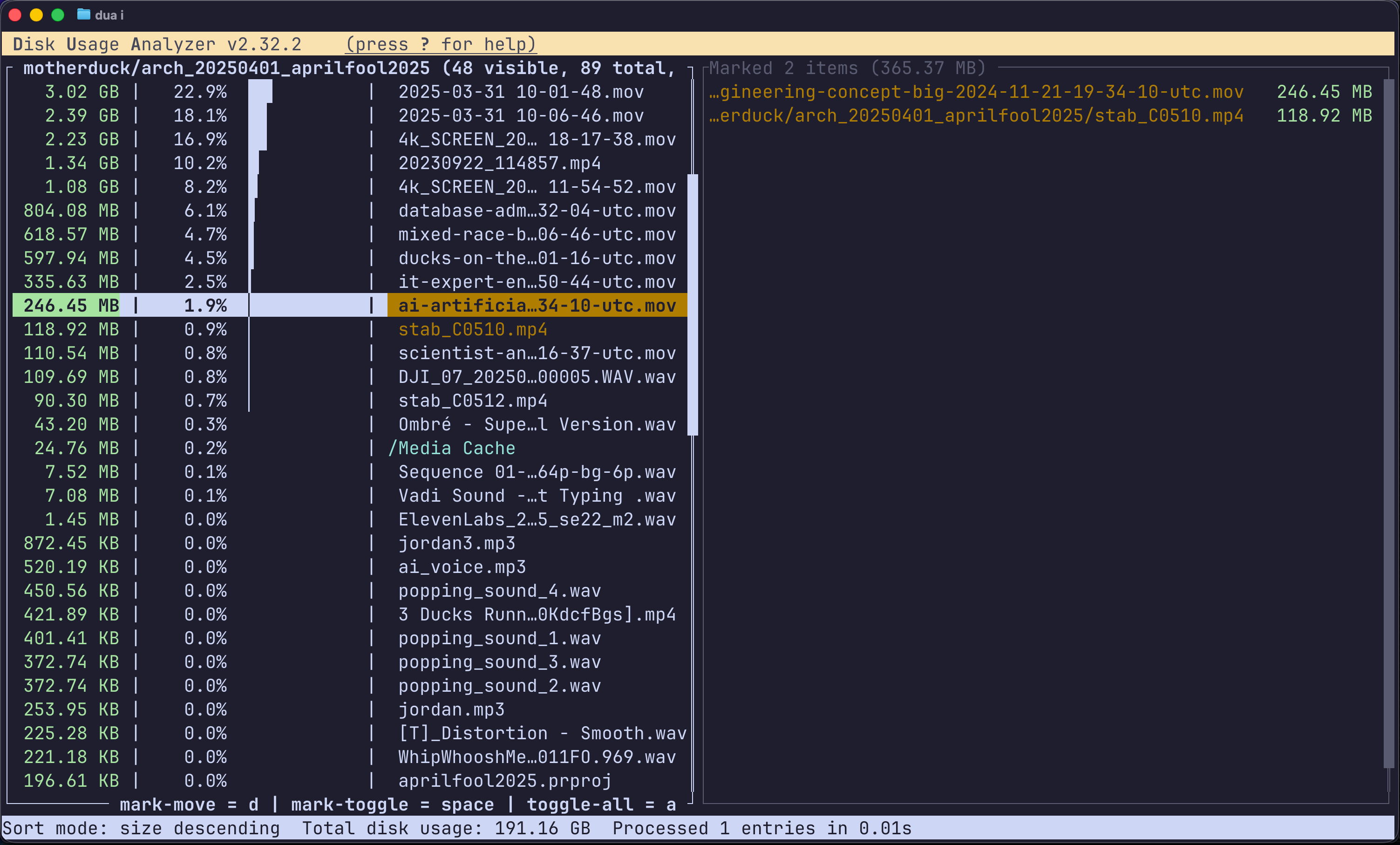
I’m a macOS user (though dua is multi-platform), and I used to rely on an OG app called Disk Space Utility. The downside? The indexing was slow. While it gave a good map, I missed the speed of the terminal. dua is an open-source fast terminal tool to view disk and manage disk space, written in Rust; you can navigate through big files in the terminal, mark them, and delete everything via keyboard commands.
I usually just go through the root / folder of my mac and launch dua i
Quick dua Cheat Sheet:
dua i: Launch interactive mode.j/k: Up/down the current directory listh/l: Exit/enter a folderSpace: Mark/Unmark the entry under the cursor.Ctrl + r: Remove all marked entries (careful!).Ctrl + t: Put the marked entries to the trash bin.?: Show all keyboard shortcuts.
🧠 Seniors are great with AI coding; Juniors are hurting themselves
Because juniors can vibecode their way through problems with AI, they are skipping the basics. They skip the fundamentals. They get quick results now at the cost of long-term skills—specifically, the technical fundamentals required for critical thinking.
I watched a great video from Lee Robinson (DevRel at Cursor) about the future of AI coding, and one comment struck me:
“To young engineers, don’t skip learning the basics.”
Joe Reis raised a similar alarm in his recent blog:
“I fear we’re building a competency debt bubble. Just as we accrue technical debt by cutting corners in code and systems, we are now accruing human debt.”
🛠️ AI did my personal finance for 2026
OK, so I went wild. I know I could use local open models with Ollama for privacy reasons, but I was lazy and decided to give Gemini/Claude a go with some static CSV exports of my bank transactions.
My biggest challenge is always figuring out categories and getting the “bigger picture” view. There are tons of tools to manage budgets, but I wondered how far I could get with just two CSVs and a good prompt.
The two main challenges I faced:
The devil is in the details: I had to set specific conditions and ask the AI to flag “unknown transactions” for me to comment on. It was a “human-in-the-loop” workflow, but with no UI—just Markdown. It gave me a list with a column where I can add comment on larger miscellaneous transactions
Weird numbers: Of course, it initially hallucinated some recurring subscriptions, assuming I had them running for the full year when I didn’t. Also other stuff that didn’t add up. It looks at some transactions then quickly do some assumptions.
I asked it to back up all data with actual sums using SQL and the DuckDB MCP server. It ran about ~30 queries locally to double-check its own math against the CSVs.
Honestly, it’s crazy how far you can get with such a minimal local setup.
📚 What I read/watched
The future of coding: Idan Gazit breaks down Octoverse 2025 : A good breakdown of which language is being used for what, all in the context of AI. Great takes for the future.
Dawn of the Brain-Rotted Zombies : Joe Reis raising the alarm on how we should teach (and learn) in the age of AI.
AI codes better than me. Now what? : Lee Robinson shared his experience coding with AI over the past year. He pushed a lot of projects he never would have been able to finish otherwise.
Will AI replace human thinking? : Another blog from Simon Späti on the same theme as above, but with much more depth, evidence, and data.
Critical n8n Flaw (CVSS 9.9) : Another week, another vulnerability exposed. This time, arbitrary code execution on n8n.
SSDs Have Become Ridiculously Fast, Except in the Cloud : An older blog (Feb 2024), but I think the take is still valid. Especially NVMe cards are crazy fast and are still lapping what is available in the cloud. It’s a good reminder to keep some hardware local.
My 6-year-old riding into 2026. Earlier this week, we went through a scary ER visit (not ski-related). First time for me—terrifying. But as you can see, he’s all good now and ready to take on 2026.
Honestly, the only thing I wish for you this year is health.

loved the `dua` cli. thankss