Wait Mehdi, almost 2 months since the last ctrl+r?!
Travel, sickness, and (not to mention) a newborn got me deep into survival mode. Bear with me while I find my rhythm again. The good news: I’ve been experimenting non-stop, so this is a triple edition : 3 🧠 thoughts on AI and 3 🛠️ tools I tried. Deep dives coming next week!
🧠 AI hurts learning without helping productivity (for new skills)
Anthropic researchers released an interesting paper last February: “How AI Impacts Skill Formation”.
They ran an experiment on 52 Python developers learning a new async library (Trio). The AI-assisted group scored 17% lower on the post-task quiz while completing the task in roughly the same time as the no-AI group. No speed gain but a real learning cost.
You can probably guess why if you’ve been in this situation: you spend too much time prompting the AI trying to figure out what you actually want, especially when you can’t assess what’s being produced because you don’t have the foundations.
This is cognitive delegation. If you’re learning something new on the job and using AI to do it for you, you’re becoming a weaker engineer over time.
As a DevRel, these findings matter a lot. I’m teaching people how to use AI and how you use it shapes not just productivity but long-term learning. That’s the part most people are missing.
🛠️ Obsidian CLI & headless client
Obsidian recently released two tools:
A CLI
The headless client is interesting. It means you can now let agents write to your vault separately from your laptop, like in CI. Combined with sync, you could run auto-tagging in a pipeline and have it pulled to your laptop or mobile the next time you open the vault.
The CLI is more pragmatic. I’ve been using Claude Code alongside Obsidian thanks to the community terminal extension, and the CLI makes common vault operations faster and cheaper on tokens because it’s built around specific patterns you’d otherwise rewrite from scratch every time with bash.
Someone did a benchmark and the speed gain isn’t massive even on a large vault, but it adds up:


There are also many other commands available like plugins. I’ve been using Claude Code to fix things around my setup: finding the right plugins, tweaking their config. Works great.
🧠 Your IP is not the code, it’s your workflows
I’ve been spending a LOT of time improving my workflows with AI.
Whether it’s figuring out which MCPs are actually useful, turning repetitive tasks into skills, or automating pipelines that would’ve taken too long to do manually and this is where I’ve been putting my energy. One big piece: all my content is now a hub on mehdio.com with stats updated daily.
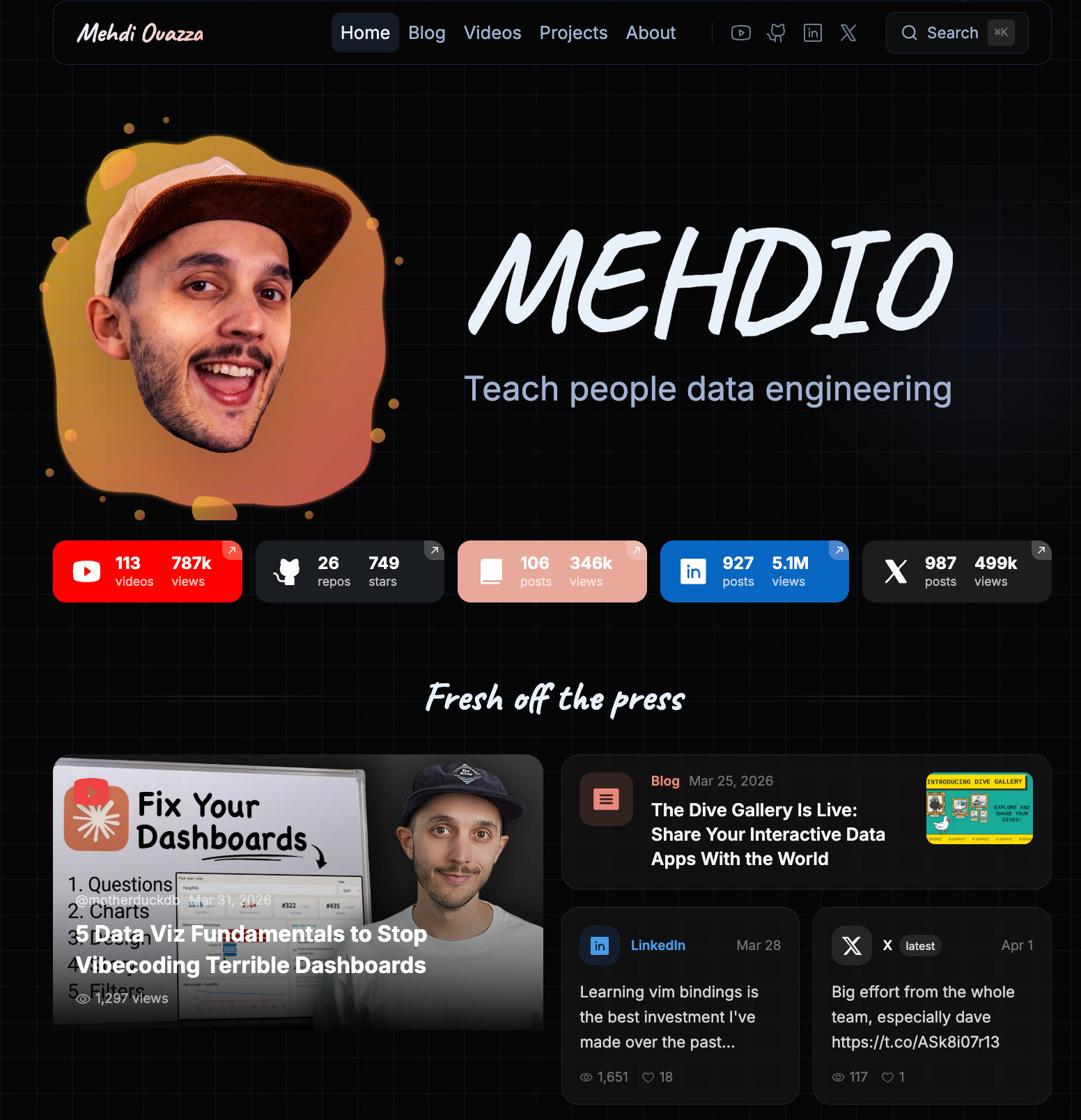
I think this is what “finding your craft” looks like in the AI era : taking every workflow and shaping it to your taste, your needs, and your creativity.
One great blog in these lines that resonate with me is one from Kaxil , I Haven’t Written a Line of Code in 4 Months (But I Ship More Than Ever). Kaxil is a committer and PMC member of the Apache Airflow project and he’s sharing the shift that has happened for him in terms of development and workflows specifically with a lot of insightful tips : a must read!
“Models haven’t improved much. Harnesses are what changed. If you’re investing in AI coding, invest in the harness.”
🛠️ More metadata for Claude Code
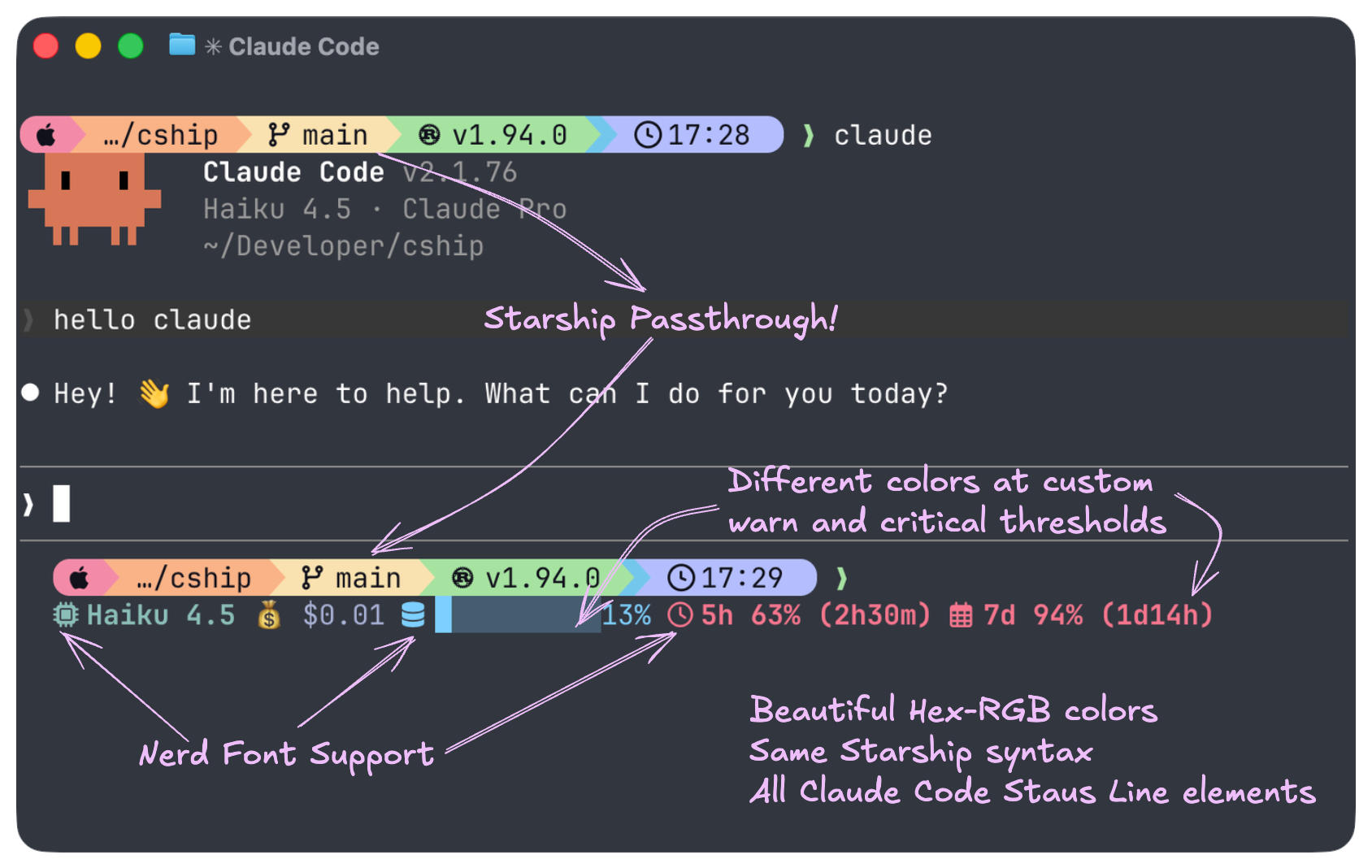
CShip is a nice little plugin for Starship that shows more information about Claude Code. I was already a Starship user, so adding this was a no-brainer. At least now I can see when I’m burning too much $$.
🧠 AI security and skills
We’ve heard wild stories with MCP servers, people going overboard on permissions and what they allow. But recent attacks on skills are also worth paying attention to.
Skills are just markdown, so they’re easy to inspect but many people use them without reading them, which hands over both security and control over their systems.
One example (among many): a supply chain attack on a Claude skills marketplace : a fake skill called “What Would Elon Do” was published by someone named Jameson. Separately, Vercel’s tooling was automatically finding and downloading skills based on what users asked, meaning a malicious skill only needs to be published once to get auto-executed across users’ systems.
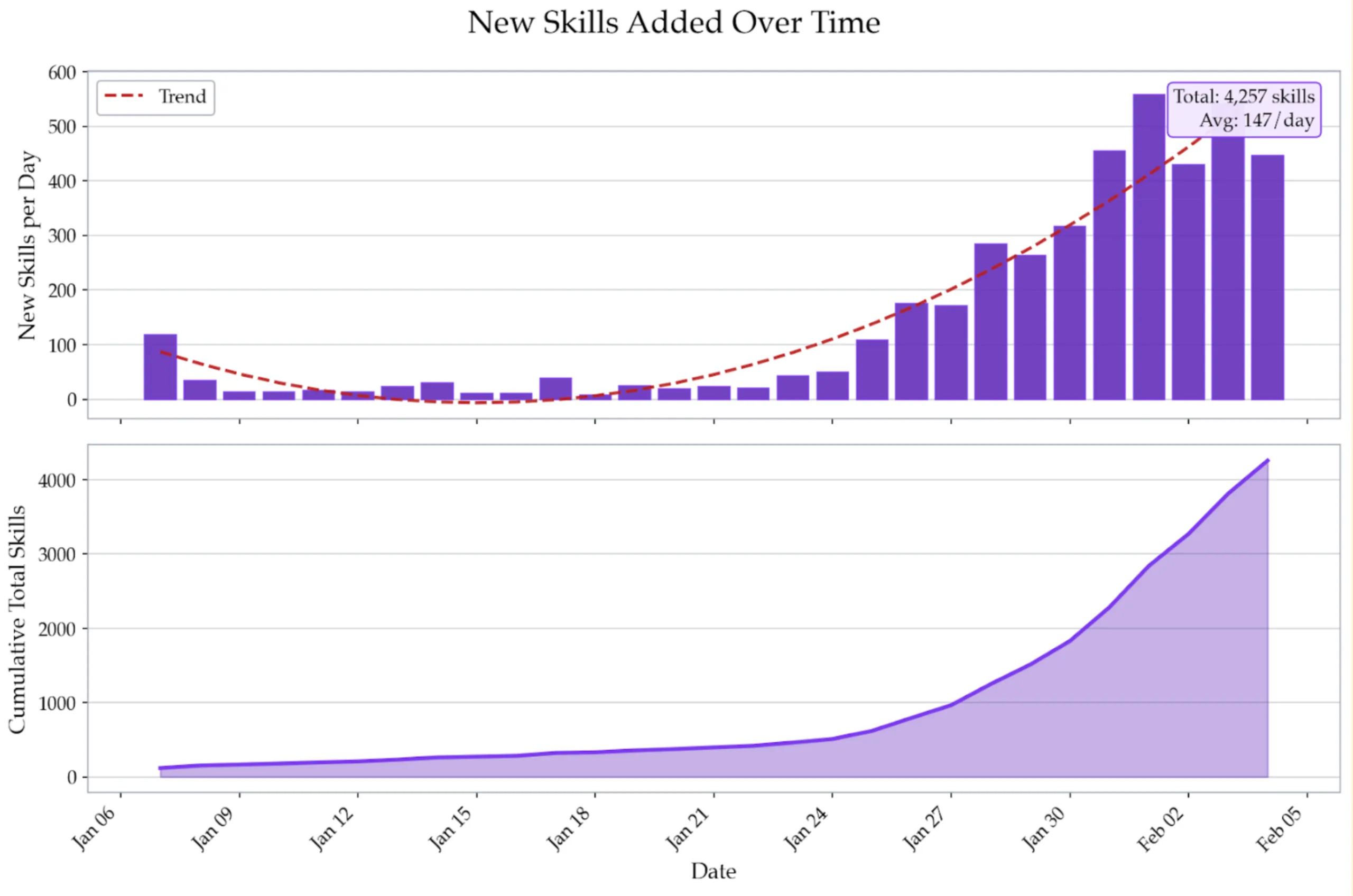
Skills have been growing fast:
Always review and understand skills before running them.
🛠️ Disappointing Google CLI
Everyone’s shipping a CLI these days and for good reason. Agents love CLIs and bash execution. One promising recent addition was the Google Workspace CLI. Could we finally get a smooth experience with Google Docs for collaborating with teammates and AI?
Short answer: not really.
Setup is rough. You need a Google developer project account (fine), but then you have to configure specific auth tokens AND authenticate through the usual GCP project maze.
And the Google Docs experience itself was underwhelming. The API sees documents mostly as one block of text so targeted edits, handling specific comments, anything contextual was a poor experience.
Then it hit me: CLIs are just another surface for existing APIs. Bad API, bad CLI.
Good API for collaborative docs? Notion. I’m an Obsidian user at heart, but I’ve been leaning on Notion as a knowledge layer for work done with Claude and updating pages, responding to comments, all of it is smooth. And because it has structured components like databases, it’s great as a lightweight internal UI too.
Point to Notion.
📚 What I read/watched
Articles
Your Data Agents Need Context by a16z: context is the problem, not the model. been saying this for a while.
AI and the Mixed-Consistency Future by Joe Hellerstein: dense one. but if you’re building on top of AI in a distributed system, you need to read this.
Manipulating AI memory for profit: The rise of AI Recommendation Poisoning by Microsoft Security: nobody’s talking about this yet and they should be.
SQL Is Solved. Here’s Where Chat-BI Still Breaks. by Julien Hurtevent: everyone’s excited about Chat-BI until they hit the edge cases. this is where it breaks.
Moats in the Age of AI by CJ Roth: code is not your moat anymore. good articulation of where defensibility actually is now.
The Last Mile is Solved by Slop by dlt Hub: the ugly ETL nobody wanted to write? AI just does it now. slop that ships > perfect code that doesn’t.
AGENTS.md outperforms skills in our agent evals by Vercel: worth reading if you’re building with agents, structured context in a file > trying to prompt your way around it.
The Semantic Layer Is Back. Here’s What We’re Doing About It. by Preset: it comes back every few years. this time AI is the reason and it makes more sense now.
Videos
I Let 30 AI Agents Loose in My Repo (Gas Town): watching 30 agents run loose on a real codebase is as messy as it sounds. you learn a lot from the chaos.
Anthropic killed Tool calling: don’t let the title fool you it’s actually a decent explainer on what changed with MCP.
Should You Learn Coding Now? Anthropic CEO Explains: headlines butchered this one. watch the actual clip.
An AI CEO finally said something honest...: short. rare moment of honesty in a sea of hype.
Is SaaS actually dead? (...no): SaaS is not dead. great reality check.
AI agent design patterns: practical patterns, not theory. good reference.
Be Careful w/ Skills: video version of what I covered in the security section above.
In reality, babies are a lot like Pokémon. Except they only take a week to evolve, and a few months before you can even narrow down what type they are...